An exercise in sameness: On uniforms, educational prestige and the language of innovation in international education
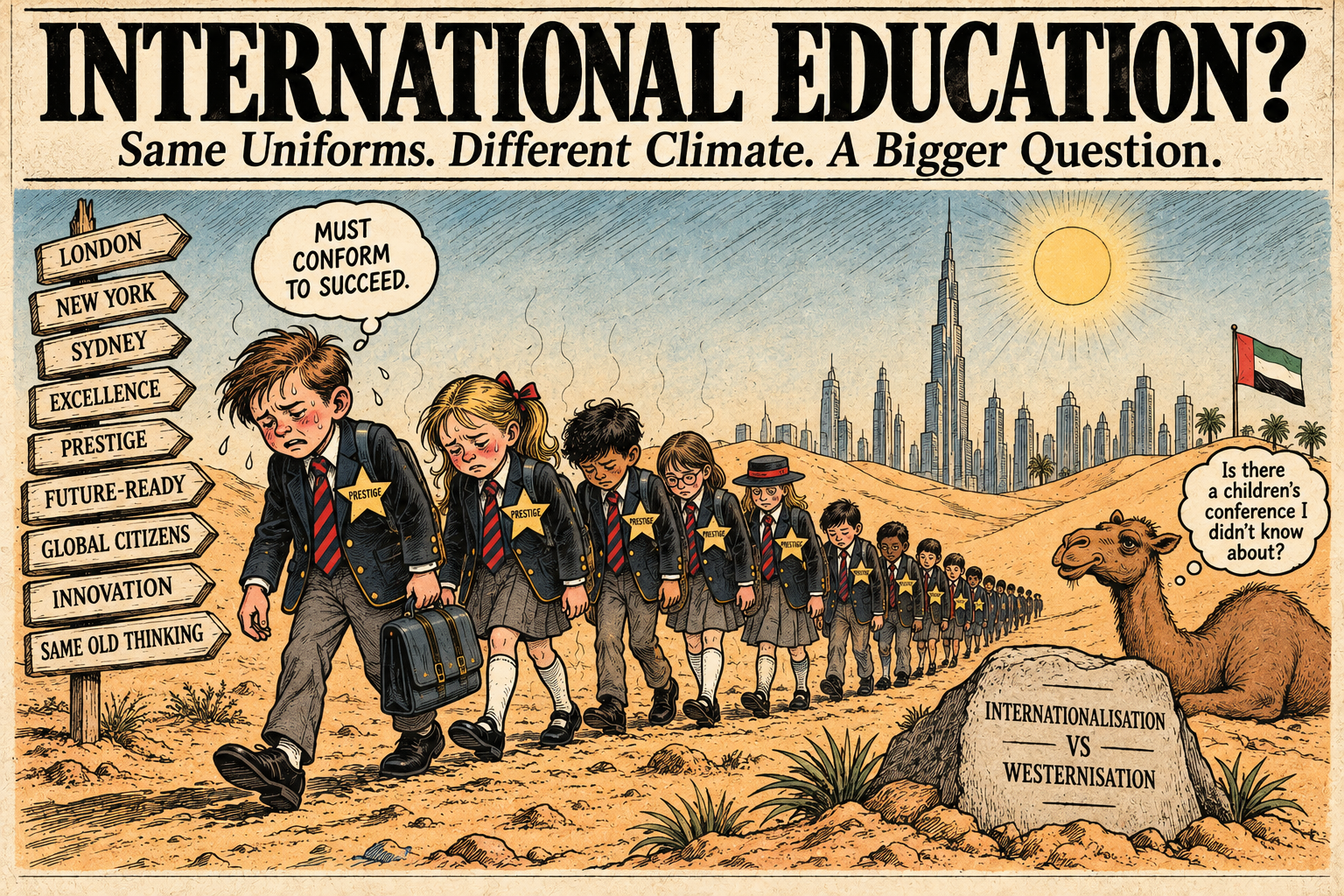
(Image generated by AI)
By Stephanie Martin
September in the UAE equals back to business and in the education sector, that means back to school.
Last week marked my first week as a school parent and having been part of the education world for 15 years, I really didn't expect to be emotional. I've been part of the system professionally and I know how it works. But there's something to be said for your first born starting the 12-13 year journey inside a system that deep down, you're not really sure that you advocate for yourself.
Surprisingly, each time I sat in the school pick up queue, I noticed a niggling internal sense of irritation. Was it the school? No. The teachers appeared to be lovely and the school leadership team open, kind and supportive of parents and children. Just what any parent hopes for.
But as I sat in yet another wave of Dubai traffic (if you know, you know), watching school children make the pilgrimage to their parent's car in 45 degree heat, dressed in trousers, ties and in some cases, a blazer, the frustration grew and the question I'd be suppressing all week finally came to the surface:
Why are we doing this?
Ironically, I've watched the international system play out in its usual fanfare for years. I've researched, lectured and published in books about the systemic gaps that exist, and for some reason in the blistering Dubai heat, here I was suddenly questioning why any of us were subscribing to it.
Perhaps it becomes more personal when you become a parent. There's a tendency to inspect things more closely when it comes to your own child. I watched on proudly as my son stood dressed and ready for his version of the real world, miles away from his extended family but very comfortably happy in the country we've adopted as home.
But here's the part that made me scratch my head a little. His first day of school life as a 5 year old came complete with a tie, long socks and enough fabric wrapped around his tiny body to make me question whether we had somehow enrolled him in a school in countryside England, rather than the Middle East. Picture a 5 year old practically wearing Ascot tie.
Cute dress ups? Sure.
Necessary for a quality learning experience? Absolutely not.
To be clear, his classroom experience so far has been wonderful. His teachers have been warm, thoughtful and attentive. This is not an indictment of the educators working in international schools, nor is it an argument against school uniforms -- we've seen enough of this over the years.
See, the blazer-and-tie isn't really the problem.
But it brought to the surface the exact argument I've been talking about for years:
Why do international schools continue to reproduce Western educational forms, aesthetics and language as markers of quality and prestige, even when those forms might be poorly aligned with the cultural, social and environmental contexts in which they operate?
Translation: Why are we preparing for the snow when we're headed for the desert?
The weight of this question is considerably bigger than my son's oversized school blazer.
What do we actually mean by "international"?
We use the word like confetti in transnational education.
International school. International curriculum. International education. Global citizenship. Global learning. The list goes on.
But how consistently are we putting the definition of these terms into practice? And have we simply become too comfortable in assuming that branding an institution as 'international' automatically means that our practices truly are?
Last year, I gave a TEDx talk that posed a simple yet thought-provoking question:
Have we mistaken internationalisation for Westernisation?
After being saved by the cool of my car air-conditioning and watching my son immediately rip off his too-big-for-me-tie, this question floated back to me. And suddenly felt far less theoretical and pointed to the exact system I found myself in.
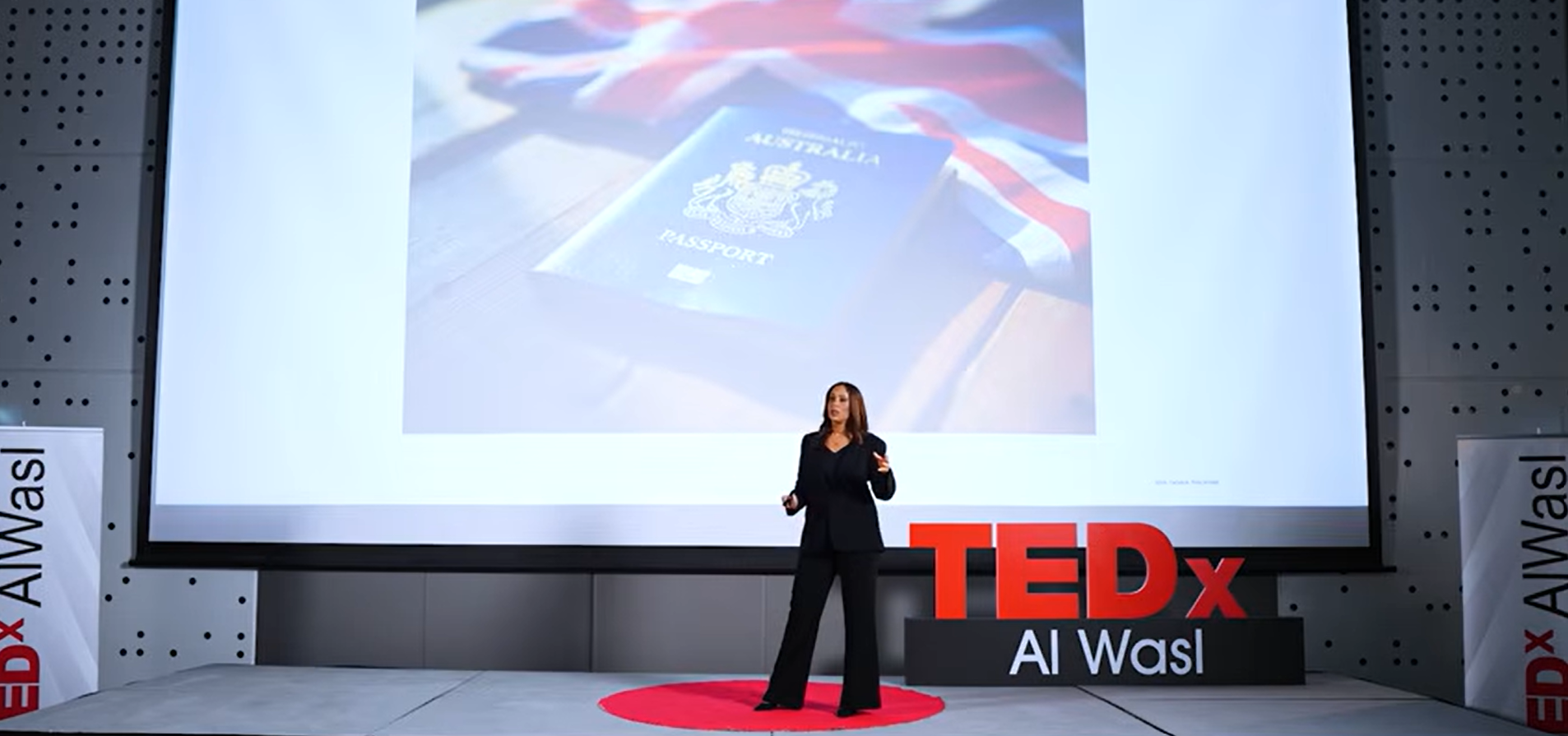
(TEDx Al Wasl, 2025)
In a country where temperatures regularly climb beyond 40 degrees, where children grow up among hundreds of nationalities, where multilingualism is part of everyday life and where the relationship between local and global is woven into almost every aspect of society, the question is why are we still doing this, and why are we still doing it here?
Not why are we educating children internationally?
Not why are we using British, American or other internationally recognised curricula?
And not even why are children wearing blazers and American baseball jackets? (Although , truth be told, I ask myself this question every time I see a high school graduation in the UAE)
But:
Why are we still fixated on reproducing and duplicating?
Why are we still mimicking educational forms developed elsewhere and presenting them as though their meaning, value and prestige are automatically transferable to any cultural context?
I once taught at an international school where the school bell was a song called "This is Australia". Contrary to some belief, ahem, Toto, we are most definitely not in Australia anymore.
The UAE is not Britain. It is not the United States. It is not Australia. It is not Finland. And yet many of the markers we have come to associate with an "outstanding" international school seemed to revolve around Western ideals. And it's not only found in the curriculum that governs each school, it's the familiar uniform choices, the terminology, the architecture, the leadership structures, the performative language of excellence or the promises of future-readiness and innovation.
There's something perplexing about that.
Is prestige only recognised when it's doused in Western-approach glitter?
Perhaps this is the question I'm really trying to get at. Why do certain educational forms carry such immediate symbolic weight? Whether it's the tie and blazer, the Western curriculum, or the accent that automatically equates to 'prestige'.
The same can be said for the language of "innovation", "global citizenship" and "future-ready learners". None of these things are inherently problematic. But somewhere along the way, we have begun to conflate familiar markers of educational prestige as evidence of educational quality.
A school can 'look international' without being particularly responsive to its context. It can use the language of innovation without fundamentally changing the learning experience. It can reproduce a highly regarded educational model without asking what needs to change when that model crosses a border. I've seen it first hand and worked with governing bodies across the ocean who've never set foot in this country, and yet, it's these same entities who stipulate what 'best practice' is for international students.
Essentially we can label an institution as excellent while it still showcases assumptions that deserve to be questioned.
Oddly, I've found myself cringing at some of the back-to-school posts this past week. And I realise that makes me sound cynical -- I'm not, promise. I genuinely believe that the vast majority of leaders and educators want to do great things. They want to create meaningful experiences and leave a lasting impact on the children in their care.
But we've become so embedded in the systems that govern us that after a while, we start to speak the same language.
Our ears prick up at the familiar, algorithmic buzzwords: future-forward, AI, future learners, innovation, transformation. Our eyes glaze over. And parents happily sign on the dotted line because these words sound familiar and mimic what is progressive.
So in a region that so readily adapts what has been labelled prestigious in order to attract and retain its large expat population, I ask where to from here?
Truth be told, I'm not sure. Perhaps awareness is the first step. But it would be worthwhile for leaders, educators, parents and policy makers to ask themselves why do we do it this way?
And if the answer is simply 'because that's how it's done in (insert home country here)' or 'because that's how it's always been done' -- therein lies the problem, folks.
Are we an education marketplace that sells 'international' without understanding what it really means to be culturally responsive?
As 2:33pm rolls around, I watch another wave of students emerge from an English-medium, Western-approach classroom and step back into the reality of the Middle Eastern heat. It almost serves as a a daily reminder of the richness of this tiny Gulf they now call home. And so -- I wonder. And I wait in hope.
I hope that the future of international education becomes less about making every school look, sound and feel the same on paper and in practice.
And I hope that transnational education continues to move away from the generic ideal that internationalism means bringing education from 'the West to the rest', as Le Ha (2017) mentions.
Instead, I hope our future here becomes more focused on creating schools that are international at their core, simply because they are deeply responsive to where they are, and who they serve locally.
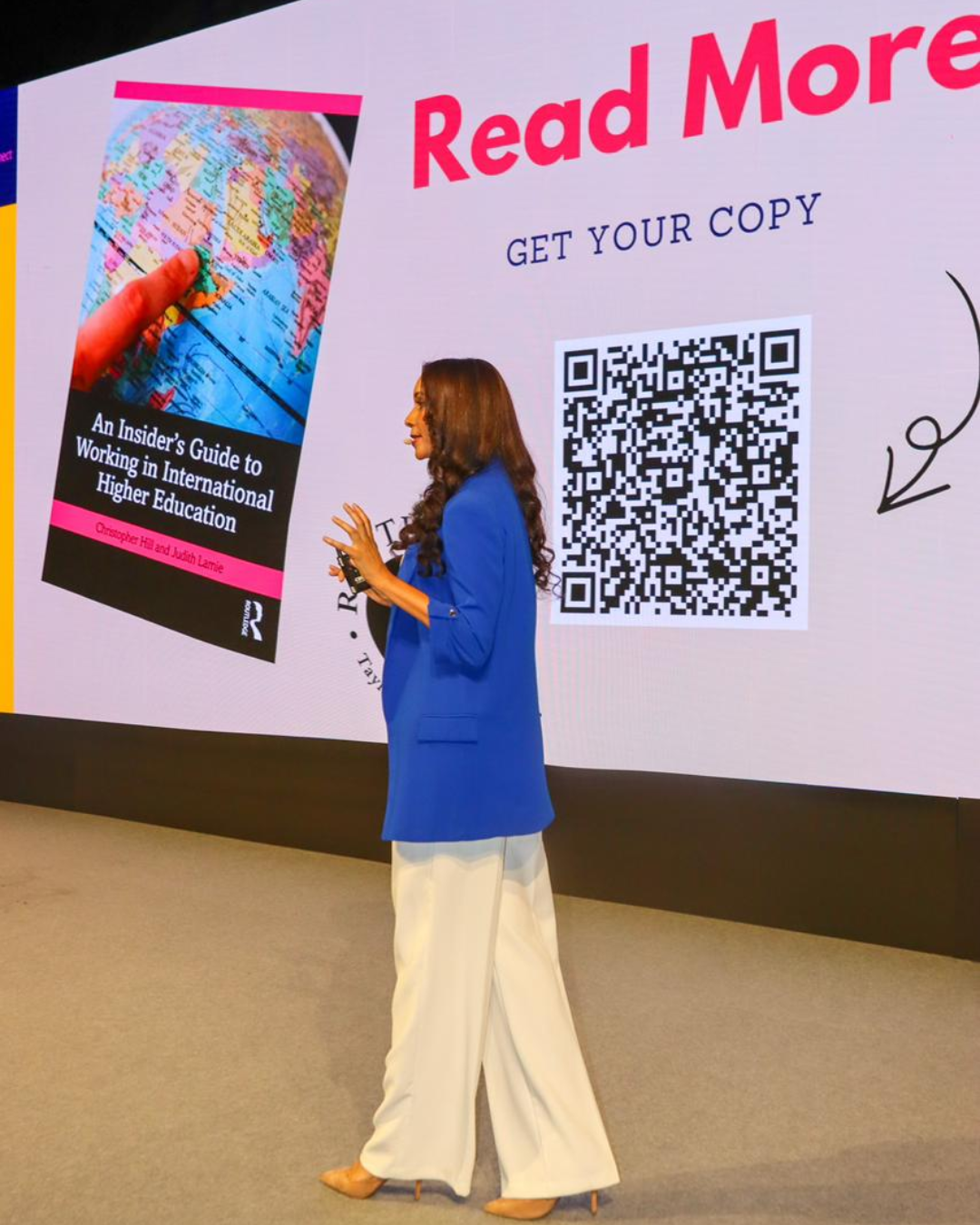
I'm Stephanie, a researcher, international keynote speaker and lecturer with background in education and communication. If you'd like to read more of my published material in Springer Nature, Routledge, Taylor and Francis group and Edward Elgar, please get in touch.
Stephanie Martin | Edvance Consultants | edvanceconsultants.com | stephaniemartin.net